


SiliconANGLE first reported on Huskeys’ launch of Profiling, a new capability designed to help organizations connect network edge security decisions with the business purposes behind application traffic. Announced on October 14, 2026, the capability creates dynamic profiles of web applications and APIs, giving security teams a broader understanding of endpoints, users, behavior, existing protections, and the business paths that matter most.
The launch addresses a persistent challenge for organizations managing complex application environments: security tools often operate independently, even when they protect the same application. Huskeys wants to bridge those gaps by providing a unified view that helps organizations apply controls according to application-specific needs rather than relying on generic rules.
Why Traditional Security Layers Can Miss the Bigger Picture
Organizations commonly use a combination of content delivery networks (CDNs), bot management systems, web application firewalls (WAFs), and application programming interface (API) security platforms. Each technology serves a different purpose, but operating them separately can limit the context available when making security decisions.
Without a shared understanding of how an application works, security teams risk blocking legitimate requests or allowing malicious activity to continue. A request that appears suspicious in isolation might be part of an important business transaction, while activity that resembles normal traffic could be attempting to exploit an application.
Huskeys Profiling is designed to provide that missing context. Rather than simply cataloging assets or discovering APIs, it examines how endpoints are used, who accesses them, how applications behave, what controls already exist, and which paths are critical to business operations.
“A profile changes the question from ‘What does this traffic look like?’ to ‘What does this traffic mean to this business?’” said Roy Weisfeld, Co-Founder and CTO of Huskeys. “Most organizations protect everything the same way, like a mall with one security team guarding every store identically, whether it’s a luxury boutique or a snack stand. We give every store its own dedicated guard, tailored to what it needs. When a sale triples the foot traffic or a new store opens, our guards adapt in real time.”
Turning Application Knowledge Into Action
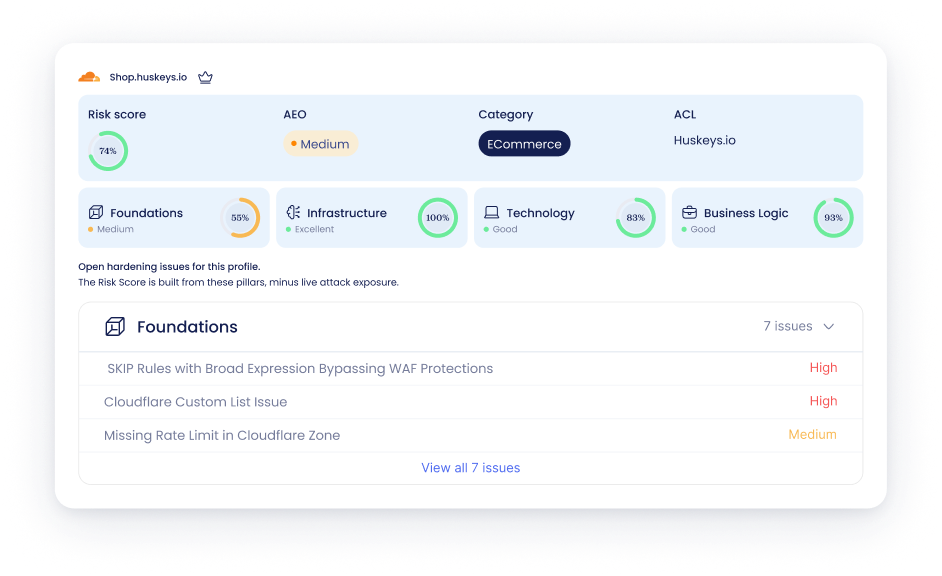
Profiling is designed to serve as the foundation of Huskeys’ Hardening Loop, a process that connects application understanding with security improvements. The system profiles a business path, detects changes, abuse, or exposure, identifies a high-impact fix, and allows the customer to approve the proposed action before the control is delivered. Huskeys then observes the impact.
The approach is intended to shorten the distance between identifying a security issue and implementing a targeted response. Instead of generating another stream of alerts for analysts to investigate, the company aims to translate findings into controls that reflect the specific application and business path.
“Once we understand the application, the intent, and the business path together, security controls can be scoped to the customer instead of relying on generic rules,” adds Yotam Mazurik, the company’s Research Team Lead. “Profiling gives us the context to turn detection into a control that is specific to the application and the business path. The customer decides; Huskeys delivers.”
The Challenge of Increasingly Automated Traffic
The launch also reflects changes in how applications are used. Alongside human visitors, organizations must account for automated systems and AI agents participating in shopping, transactions, and other application workflows.
The press release cites Cloudflare’s 2026 reporting that automated agents and bots accounted for more than half of web requests across its network. As AI-agent activity grows, determining whether automated requests are legitimate or malicious becomes more difficult when security teams rely primarily on traffic patterns.
Huskeys argues that understanding the purpose of an application path provides an additional basis for making these decisions. That context can help organizations determine which requests should be permitted, challenged, or blocked.
The company also sees application-aware protection as a way to prepare for exploitation before an incident occurs, particularly as the time between vulnerability disclosure and exploitation continues to shrink.
“Security teams have spent years trying to respond faster,” Weisfeld said. “We believe there is another approach: understand what matters before the next incident, so you can remove the window instead of racing the clock.”
A More Contextual Approach to Edge Protection
Profiling is available in beta for close Huskeys customers. The company says implementation requires no special onboarding and that customers can begin seeing value within hours.
The capability supports Huskeys’ broader Network Edge Security Management (NESM) platform, which connects existing CDNs, WAFs, cloud security, and network edge technologies through a unified agentic layer.
By tying security decisions to the business functions applications support, Huskeys is pursuing a model in which protection adapts to operational needs rather than treating every endpoint and request identically. Its objective is to strengthen security while minimizing false positives and maintaining business continuity.