

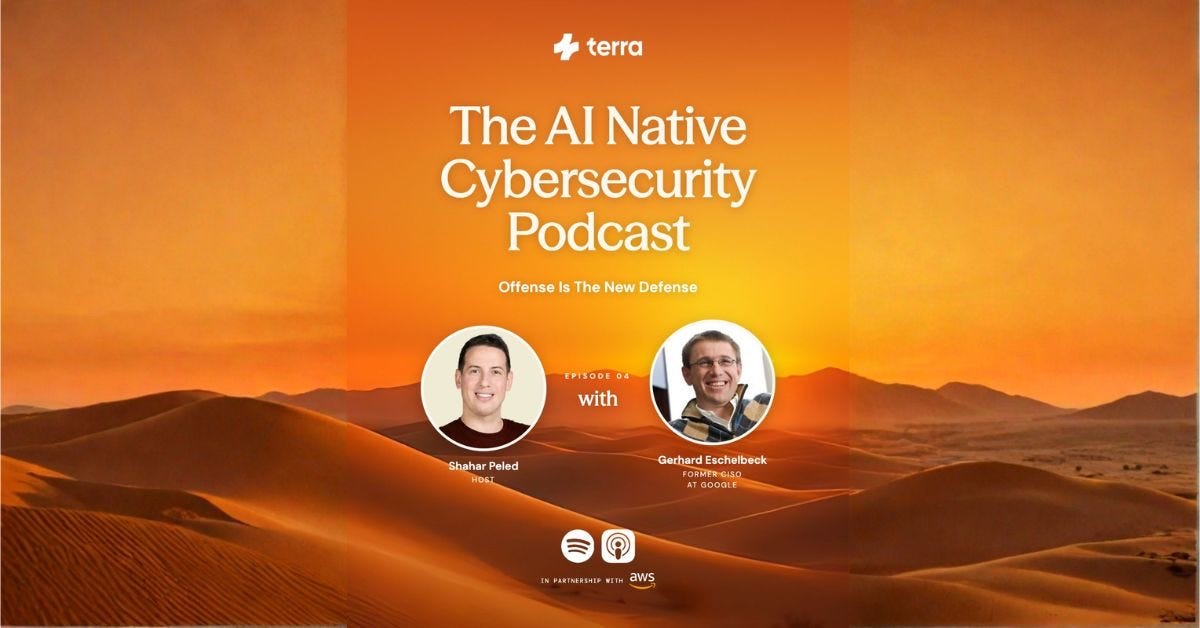
Offensive security has long been a modest line in cybersecurity budgets. Companies bought it as a service engagement, scoped it to a small part of their systems and repeated it once or twice a year. As AI speeds up both the discovery of vulnerabilities and the tools that exploit them, that model is under pressure. The shift frames the November 17, 2026, episode of the AI Native Cybersecurity podcast from Terra Security, a company working in autonomous penetration testing.
Episode 4 features Gerhard Eschelbeck, former Chief Information Security Officer (CISO) of Google, in conversation with host Shahar Peled. Eschelbeck has nearly 30 years in the industry, including early roles at McAfee and Qualys, and co-created the Common Vulnerability Scoring System (CVSS). The discussion was recorded at Black Hat and covers Google’s position in AI-era security, the economics of advanced models such as Mythos, the continuing value of human oversight and Eschelbeck’s view that today’s startups could produce the next generation of large security companies.
Offensive Security Moves From Project to Platform
Peled set out the market thesis directly. Penetration testing, red teaming and ethical hacking have historically drawn a small share of spending, though they were never cheap. They were sold as point-in-time projects scoped to a narrow part of the attack surface, and few organizations could test most of their environment more than once a year or once a quarter. He believes CISOs are now moving from reactive defense toward proactive testing that mimics adversaries, because vulnerabilities alone have become unmanageable. Code changes, new Common Vulnerabilities and Exposures (CVE) entries, new AI models and misconfigurations change attack surfaces daily, sometimes hourly.
Eschelbeck agreed that the opportunity is large. Any change to a code base now affects the production environment directly, so testing has to cover the whole chain rather than source code or production alone. “AI is the tool to allow us to leverage penetration testing in an automated way,” he said, describing testing that can run regularly, frequently and mostly or partially autonomously.
Speed and Scale Redraw the Risk Picture
Eschelbeck sees AI as a major technology shift that lets companies, individuals and governments get more value from their data. It has also created a large set of new security challenges. He estimates that the speed, scale and volume of vulnerabilities have grown by roughly an order of magnitude from a year earlier, and AI has added new issue types such as prompt injection. When Peled described AI as an attack surface in its own right, Eschelbeck agreed.
Peled observed that most attacks so far, autonomous or not, have exploited familiar vulnerability types at a new scale and pace. Eschelbeck added that attackers now increasingly chain individual weaknesses, which shifts attention from single-vulnerability severity to attack graphs. That shift, he said, is a reason to revise CVSS or build an entirely new scoring system for the AI world.
How Is Google Positioned in AI-Era Security?
Peled noted that, in his view, Google is the only company that holds the entire AI value chain, from data centers and chips to models, inference and applications. He also pointed to Google’s acquisition of Wiz as a significant security move. Eschelbeck, drawing on his years as CISO, described Google as a constant target, backed by proprietary infrastructure and one of the most powerful security organizations he has seen. He recalled the company pioneering Zero Trust and passwordless work years before those ideas reached the open market.
On whether Google will push harder into the security market, Eschelbeck expects large AI organizations to use their compute scale to help security, mainly through tooling. He doesn’t think Google will necessarily become a security company, but he said “the tooling that they will be providing will help many of us, many of the CISOs in the world to build better security for organizations.”
The Price Tag on Mythos-Class Models
Eschelbeck said Mythos, one example among several advanced models, has already had a tremendous impact, contributing to a large wave of security patches in recent months. He believes such tools reduce the advantage attackers held in the past by giving defenders the same capabilities. When Peled suggested the attention had run ahead of reality, Eschelbeck said media attention always accompanies something new and would balance out over time. He also flagged cost as a factor buyers are starting to notice. “It’s not cheap, they’re super expensive,” he said, adding that the models are slow as well.
Agent adoption brings its own governance question. Following a recent incident involving OpenAI and Hugging Face, in which Peled described agents escaping a sandbox into a real environment, Eschelbeck called for better guardrails. “Agents are everywhere. How does an organization now manage and supervise those agents in their environment?” he asked. Peled added that agents built on different providers’ models, with different guardrails and open-source tools, amount to a new supply chain within AI.
Why Human Oversight Still Matters Commercially
Using Waymo as a reference point, Eschelbeck noted that the car took more than a decade to reach its current level of autonomy. He believes cybersecurity sits at the human-guided autonomy stage, where autonomous vehicles were five to ten years ago. “We are better off today with optionality where we take advantage of the AI-based scale together with the human decision-making,” he said. He hopes the field reaches full autonomy within the next decade and expects human involvement to decline over time.
Will Startups Produce the Next Security Giants?
Asked for a 12-month prediction, Eschelbeck pointed to the startup ecosystem as the place to watch. He follows many early-stage founders, and he cited Terra Security’s work in autonomous penetration testing as an example. When Peled summarized his view as the next wave of large security companies coming from startups rather than today’s incumbents, Eschelbeck replied, “That’s exactly right.” Peled offered his own variation: the cyber giants will likely remain giants, while mid-sized vendors may be the ones startups overtake.
Eschelbeck cautioned that external factors make long-range forecasts difficult. “Three years ago, nobody predicted this rapid growth of AI,” he said, and five years out is hard to call. The coming year looks clearer to him: early-stage companies will keep building and succeeding. One gap he named, a single view that shows a board what an attacker could achieve today, is in his words “the next startup opportunity.”