

Migrating security infrastructure or introducing new data sources can create a complicated engineering process for organizations. Detection rules must be configured for the available data, pipelines need to deliver information in the expected format, and changes must be validated before they affect production environments.
For security teams working with increasingly dynamic infrastructure, maintaining visibility across these dependencies is becoming an important part of managing detection and response.
Fig and Elastic have announced an integration partnership designed to address this challenge. The collaboration combines Elastic Security’s open, agentic security operations platform with Fig’s deterministic Security Data Lineage, giving engineers a way to map detection dependencies, identify broken data flows and validate changes before deployment. SiliconANGLE first reported on the partnership.
The integration is intended to support both organizations adopting Elastic Security and existing users expanding or modifying their environments.
A Challenge That Extends Beyond Platform Migration
Moving detection rules between security information and event management platforms is not simply a matter of transferring configurations. Rules depend on the structure and availability of the data they process, and those requirements may not automatically align with a new environment.
Elastic’s Automatic Migration translates existing detection rules for organizations moving from another SIEM platform. However, engineers still need to understand whether the translated rules work with the data available in Elastic.
Fig addresses this part of the process by checking translated rules against the destination environment before cutover. It identifies rules that require rework and recommends fixes, helping teams determine where detection logic and available data need to be aligned.
This validation provides a way to identify potential problems before organizations complete their migration.
The same capabilities extend beyond migration projects. Existing Elastic users can apply them when introducing new data sources, modifying pipelines or expanding detection use cases.
Understanding What Each Detection Rule Depends On
The technical foundation of the integration is Fig’s Security Data Lineage, which maps how information moves through an organization’s security data environment.
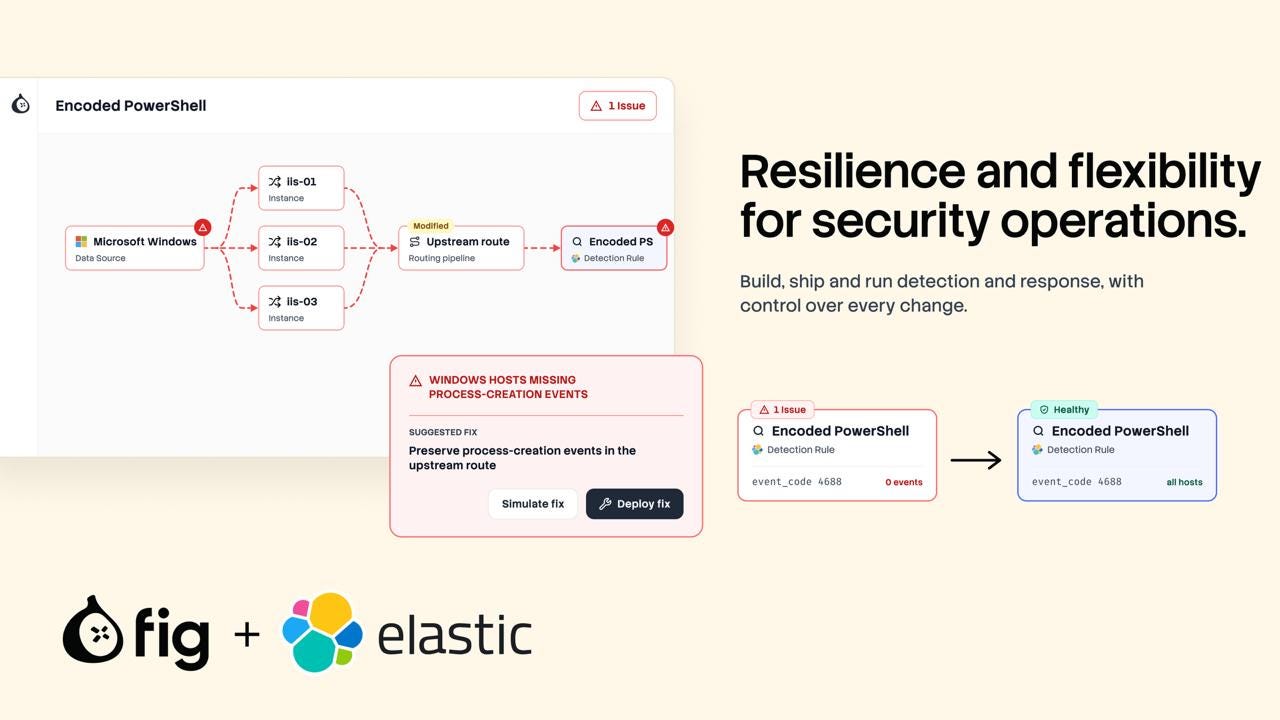
Fig connects to Elastic through a read-only API key to retrieve configuration information. It then maps data sources through pipelines, mappings and fields to the detection rules that rely on them.
This dependency map gives engineers visibility into the information required by individual rules and how changes to upstream infrastructure may affect downstream detection coverage.
The need for this visibility stems from a recurring problem in security engineering. Detection rules can remain active even when changes to incoming data remove or alter the fields they depend on. Vendors may update log formats, new sources may be introduced, or engineering teams may reshape pipelines for cost and performance.
These changes can leave detection rules without the information needed to identify the suspicious activity they were designed to catch.
When a source, pipeline or mapping changes, Fig identifies affected detections, pinpoints where the data flow has broken and recommends a fix. Engineers can use these findings to investigate the issue and assess how to address it.
Combining Elastic’s Security Capabilities With Fig’s Validation
Elastic Security provides prebuilt integrations and research-backed detection rules that help organizations establish broad coverage from day one. As their requirements grow, teams can use Elastic’s Automatic Import and AI Agent to build new integrations and custom detection rules.
Fig works alongside these capabilities by testing changes against the organization’s data and environment context before production deployment.
“Elastic gives security teams control over their data, and Fig gives them control over the engineering around it,” said Gal Shafir, Co-Founder and CEO of Fig. “Teams can see how every source connects to every detection, test each change against their own environment and ship it as code. That lets them move quickly without losing sight of their coverage.”
The integration also supports deployment through continuous integration and continuous delivery workflows. Engineers can ship validated changes as code while using version control and one-click rollback to manage deployments.
This connects the process of making an infrastructure change with the need to understand its expected effect on detection coverage.
Keeping Pace With Changing Environments
For Elastic, the partnership addresses an ongoing challenge associated with maintaining security coverage across evolving data environments.
“Environments never stop changing, from vendor schemas and APIs to ETL tools and pipelines. Fig traces those changes to the detection rules that depend on them, so SecOps teams can adapt quickly and maintain detection coverage with Elastic Security,” said Jamie Hynds, Director of Product at Elastic.
The integration is designed to help security engineers maintain this visibility as their organizations introduce new sources, modify existing pipelines and develop additional detection capabilities.
Rather than treating detection engineering as a process that ends once rules are deployed, the combined approach connects configuration changes, dependency mapping, validation and deployment.